FIG Foundation - Building a Sustainable Future

|
FIG Foundation Academic Research Grant 2024-2025 awarded to
Abdullah Kara

The FIG LADM Project is an
important step towards the finalisation of ISO Standards of LADM

|
The project manager of the FIG LADM Project is
Abdullah Kara, assistant professor at Gebze Technical University in Turkey.
|
Content:
What is LADM?
The Land Administration Domain Model (LADM) is an internationally
recognised ISO standard series (ISO 19152-x) that provides and supports responsible
innovation and partnerships, for effective land administration. The LADM
aligns the information model with a standardised global vocabulary for land
administration. As an international standard it can stimulate the
development of software applications and may accelerate the implementation
of land administration systems that support sustainability objectives. The
Land Administration Domain Model is developed at the initiative of FIG, as
part of the FIG Standards Network as well as Commissions 3 and 7.
LADM Edition I (2002-2012) - adopted by over 50 countries
LADM Edition I was published in 2012 with
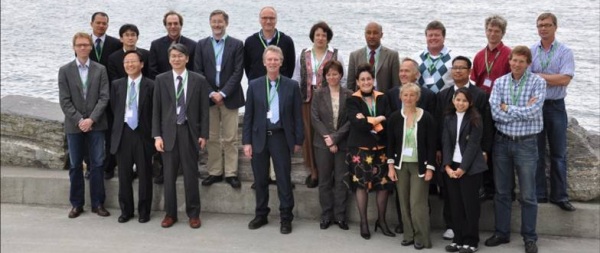
a focus on land registration. In the photo below is the 2012
Editorial Committee of the ISO 19152 (photo: Bjørnhild Sæterøy). The 1
November 2012 milestone was mentioned in this
FIG news item when the ISO standard for the 'Land Administration Domain
Model (LADM)' was approved as an official International ISO Standard. You
can read more about the LADM Edition I work 2002-2012 in
the final report.
LADM Edition II (2017-2025)
LADM Edition II is the
revised version of the LADM Edition I.
In 2017, after widespread international adoption and
feedback from users, including national mapping agencies, academic
institutions, and international organizations, it was clear that a
revision was needed, for several reasons:
- Broad adoption: Over 40 countries developed national LADM profiles.
- Demand from the land administration community: Users requested
support for marine georegulation, valuation and spatial planning data, a
refined survey model and implementation support.
- UN-GGIM support: In 2017, the UN-GGIM Expert Group concluded that a
revision was necessary to improve tenure security and land
administration coverage.
- ISO review: A formal review process began in 2018, leading to the
decision to redesign LADM as a multipart standard.
The work on LADM Edition II was initiated in
2017 at a UN-GGIM meeting in Delft, the Netherlands. From 2017-2025, LADM
Edition II workshops have been held in the Netherlands, Croatia, Malaysia,
Sweden, and Brazil [1,
2].
Goals
The goals of LADM Edition II are to:
- refine the existing content and extend the scope of Edition I to
include land value, land use and land development.
- integrate diverse land administration functions and ensure
interoperability across institutional domains.
- provide a foundation for the development of digital land
administration ecosystems, improve the quality and comparability of
land-related data, and support international efforts to achieve
Sustainable Development Goals (SDGs), particularly SDG 1 (No Poverty),
SDG 11 (Sustainable Cities and Communities), and SDG 15 (Life on Land).
- support tenure security, support access to credit, enable fair
taxation, contribute to peace building and security, promote social
justice, strengthen disaster management, improve resource management,
foster smart and resilient societies, support sustainable land use,
protect the environment, enable slum upgrading, improve access to
housing, enhance city management, and ensure access to basic
infrastructure.
- Implementation support.
The key differences between LADM Edition I and II are:
| LADM Edition I (2012) |
LADM Edition II (2025) |
| Single unified standard |
Multipart standard with six distinct parts |
| Focused on basic land administration |
Includes land registration, cadastral
surveying, marine georegulation, valuation, spatial planning, and
implementation aspects |
| Limited semantic richness |
Enhanced semantic modeling and code lists |
| One NWIP (New Work Item Proposal) |
Separate NWIPs for each part of the standard |
| Less modular |
Modular structure allows tailored implementation |
Edition II is divided into 5 parts:
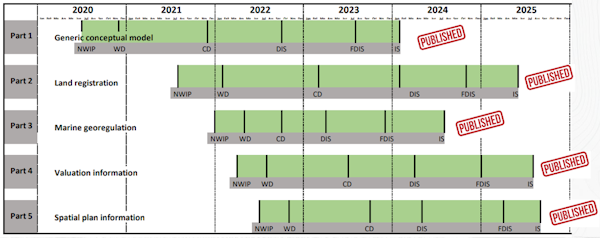
In the final report, each
part of LADM Edition II is outlined:
Each part is developed as a separate ISO standard, allowing for more
focused and flexible use.
In December 2025, the project was completed with this
final report.
Read news item January 2026.
Two FIG publications as a result of the LADM project
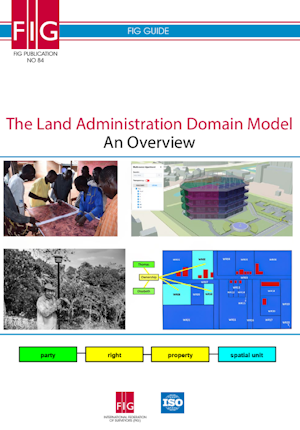
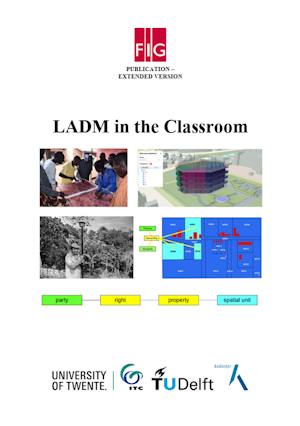
In April 2025, two publications on Edition II were published:
-
FIG Publication No. 84: The Land Administration Domain Model (LADM)
- An Overview (pictured below).
-
FIG Publication - Extended version: LADM in the Classroom (pictured
below)
The LADM project is led by Abdullah Kara and supervised
by Peter van Oosterom and Christiaan Lemmen.
In December 2025, the project was completed with this
final report:
Read news item January 2026.
Relevant links:
FIG Office and Abdullah Kara
Updated 26 January 2026
|


























